

Food safety records for aged care and hospitals
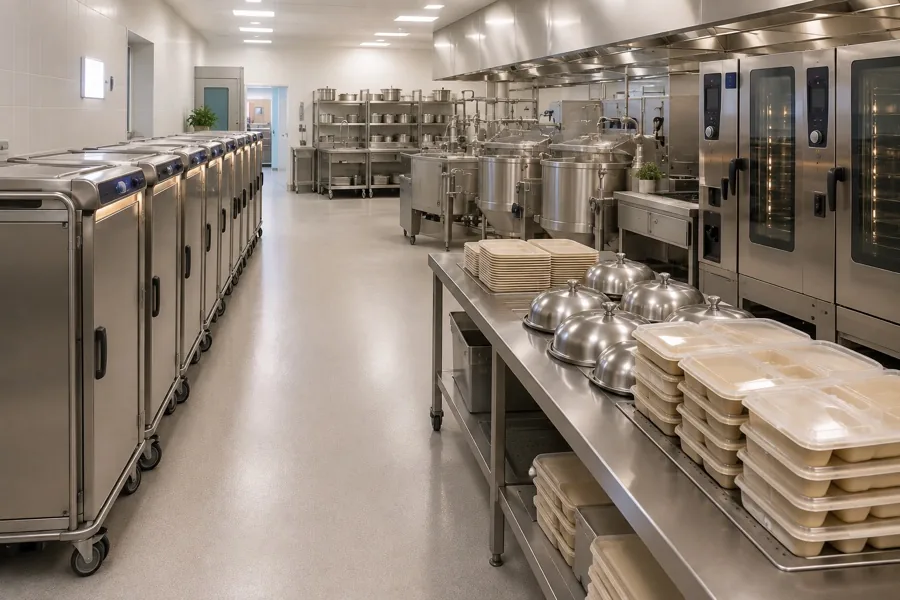
Texture modified meals, trolleys that travel to the wards and residents more at risk from foodborne illness. The daily records your food safety program points at are kept here, dated and together.
30 day free trial.
Introductory offer: Essential at A$185 a month for your first three months.
- Available on theApp Store
- Available on Google Play
What applies to you
A hospital or aged care kitchen is usually category one under Standard 3.2.2A, and the WA Department of Health guide names hospitals among its category one examples. What sets this sector apart is Standard 3.3.1, which sits on top of it.
- Food safety supervisorApplies
- Appointed before food is handled and reasonably available while it is, with a certificate issued within the last five years. Guidance suggests appointing a replacement when a supervisor is away for more than about a month.
- Food handler trainingApplies
- Every food handler needs a course, or skills and knowledge that match the work, before they first carry out a prescribed activity. In a facility under Standard 3.3.1, training records must be kept.
- Records, or another way to show controlApplies
- Keep records, or show an authorised officer another way, under Standard 3.2.2A. Your food safety program sets its own records and how long they are kept, and the three month minimum never shortens that.
- A written food safety program
- Standard 3.3.1 applies where three things hold at once: a facility listed in its Schedule, such as a hospital, hospice or aged care home, potentially hazardous food, and six or more vulnerable persons at any given time. Where it applies it brings a written food safety program kept at the premises, reviewed each year and audited by an approved auditor, with audit reports kept for four years. Hospitality Shield is not that program and does not claim to be. It holds the daily records the program points at.
- Other regulators
Residential aged care also answers to the Aged Care Quality and Safety Commission, and hospitals to their own licensing and accreditation. Those standards are not summarised here.
- Also worth knowing
The Code sets no extra temperature rule for vulnerable persons. FSANZ lists of higher risk foods are guidance, until a facility writes them into its own program, which then binds it.
This is general information about the law, not advice about your business. Confirm your category and what applies to you with your local government.
What your program points at, and where it sits
- The written program
- Documents, with each revision kept.
- Monitoring at the points it names
- Checklists written in the program's own words, with the boxes and times it sets.
- What to do when a limit is missed
- Corrective actions with a due date and a close.
- Training records, which a facility under Standard 3.3.1 keeps
- The training register.
- Audit reports
- Documents, filed as audit reports.
- Records for the period the program sets
- The record book, for the dates you choose.
The program is yours and your auditor's. Hospitality Shield holds the daily records it asks for.
A day in a hospital or aged care kitchen
- 01
Trolleys leaving for the wards
A check at dispatch records the temperature of the meals as the trolleys leave, or the time until they are served.A check at dispatch records the temperature of the meals as the trolleys leave, or the time until they are served.
Recorded in Today's Tasks and checklists
- 02
Texture modified batches cooled ahead
Purées made in advance are cooled and logged from 60°C to 21°C and then to 5°C, with the time at each step.Purées made in advance are cooled and logged from 60°C to 21°C and then to 5°C, with the time at each step.
Recorded in Today's Tasks and checklists
- 03
Cool rooms and ward pantry fridges
Every cool room and pantry fridge on a ward is a unit in the equipment register, with its own check and its own safe range.Every cool room and pantry fridge on a ward is a unit in the equipment register, with its own check and its own safe range.
Recorded in Temperature checks from the equipment register
- 04
A resident's allergy
Recipe cards carry allergens up from their base recipes, so the menu shows everything a dish contains, sauces included.Recipe cards carry allergens up from their base recipes, so the menu shows everything a dish contains, sauces included.
Recorded in Recipes and menus with allergens
- 05
Training records the program needs
The training register shows who has completed which training and when, which a Standard 3.3.1 facility must be able to show.The training register shows who has completed which training and when, which a Standard 3.3.1 facility must be able to show.
Recorded in Training and the training register
- 06
Certificates and reports with expiry dates
The supervisor certificate, pest control reports and past audit reports sit in Documents with their dates, and an expiry date where one applies, ready for the next audit.The supervisor certificate, pest control reports and past audit reports sit in Documents with their dates, and an expiry date where one applies, ready for the next audit.
Recorded in Documents
Between one audit and the next
In WA a facility under Standard 3.3.1 is audited every six months at first, adjustable to between three and twelve months.
The audit
The report goes in Documents, filed as an audit report. Audit reports are kept for four years.
The months between
Daily records at the points your program monitors, and a monthly check that they cover the period it sets.
The yearly review
A checklist set to a date once a year brings the review up in Today's Tasks, and the revised program goes in Documents with the earlier version kept.
The next audit
The record book prints whatever period the auditor asks to see.
A starter checklist set
For an aged care or hospital kitchen we would keep every standard check, add a dispatch check for the trolleys, and check each month that your records cover the period your program sets.
Start free trialOpening cool room and fridge temperatures, including ward pantry fridges
Opening freezer check, food hard frozen
Receiving deliveries log
Cooking and pathogen reduction log
Cooling log
Reheating log
Meal trolley temperatures at dispatch
Staff fitness for work
Daily cleaning and sanitising sign off
Weekly deep clean
Pest check
Stock rotation and use by audit
Probe thermometer calibration
Allergen matrix review
Supplier allergen specifications
Food Safety Supervisor and training register
Record retention check, against your program
Every new venue opens with the same standard daily, weekly and monthly lists. This is how we suggest shaping them, and every check and every list can be changed or deleted.
Guardian for aged care and hospitals
For an aged care or hospital kitchen, the officer's review can read the daily records against the points your food safety program says are monitored. The officer is not your approved auditor and does not replace the audit.
On the Guardian plan a Hospitality Compliance Support Officer (HCSO) reviews your records online, wherever you are, and on site in Western Australia where visits are available. The officer is not an authorised officer: they cannot certify your venue or speak for your local government.
Related kinds of venue
Asked about aged care and hospitals
Is Hospitality Shield our food safety program?
No. A Standard 3.3.1 program is a written document kept at the premises, reviewed each year and audited by an approved auditor. Hospitality Shield holds the daily records the program points at, dated and kept together.
Does the six person threshold apply to us?
Standard 3.3.1 applies only where a listed facility serves potentially hazardous food to six or more vulnerable persons at any given time. A listed facility serving five or fewer is outside it, and Standard 3.2.2A still applies.
How long do we keep our records?
As long as your food safety program says. The three month minimum in Standard 3.2.2A is a floor, and it is never a reason to discard records a Standard 3.3.1 facility still needs.
Is there a special temperature rule for vulnerable persons?
No. The Code sets no additional temperature rule. FSANZ guidance on higher risk foods becomes binding only if your facility writes it into its own program.
Can the Guardian officer act as our auditor?
No. An approved auditor audits the program, and a Hospitality Compliance Support Officer is neither an approved auditor nor an authorised officer. The officer's review is a second look at your records between audits.