

Food safety records for catering and events
Food made in one place and served in another, with a van, a hot box and a borrowed kitchen in between. The records go with whoever is on the job.
30 day free trial.
Introductory offer: Essential at A$185 a month for your first three months.
- Available on theApp Store
- Available on Google Play
What your client asks for before the booking
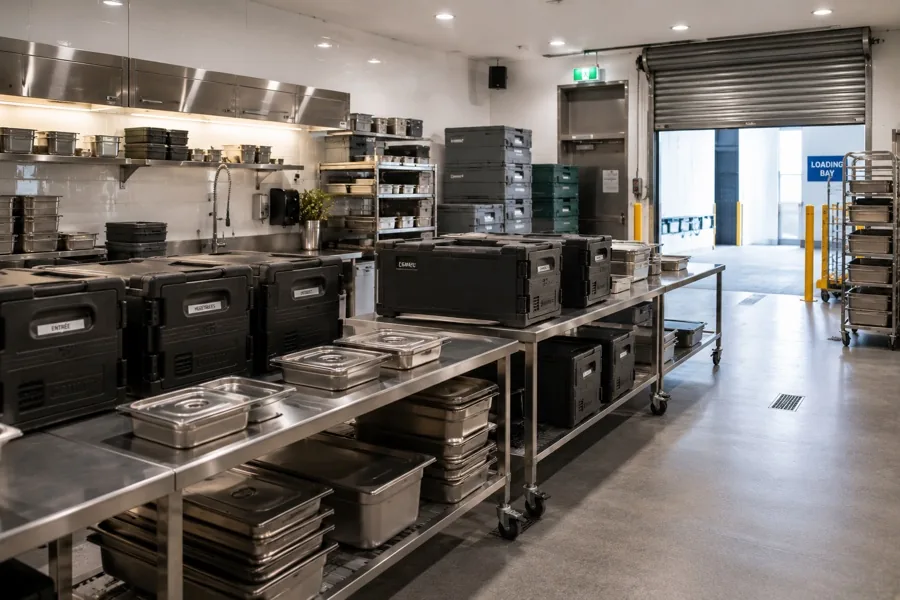
An event client, a venue manager or a hospital ordering meals may ask what is in the food and how it is handled. The record book prints the recipes and menus for the event with their allergens, and afterwards the checks, temperature readings, corrective actions and incidents for the dates you choose. No law asks you to share these with a client. It is the record you already keep, set out for someone else to read.
Recipes and menus
Checks
Temperature readings
Corrective actions
Incidents
A day in your catering kitchen
- 01
Cooking the day before
The cooling log records each batch and how long each stage took.Large batches cooked ahead are cooled from 60°C to 21°C within two hours and to 5°C within a further four. The cooling log records each batch and how many minutes each stage took.
Recorded in Today's Tasks and checklists
- 02
Loading the van
Each trip is logged with the date and the food's temperature, or the time it spent out of temperature control on the way.Each trip is logged with the date and the food's temperature, or the time it spent out of temperature control on the way.
Recorded in Today's Tasks and checklists
- 03
Hot boxes at the venue
Food kept hot until service is held at 60°C or above and read on the hot holding check once it is set up.Food kept hot until service is held at 60°C or above and read on the hot holding check once it is set up.
Recorded in Today's Tasks and checklists
- 04
A guest with a nut allergy
The event menu is built from recipe cards, so the answer to what is in the canapés is the same at the venue as it was in the kitchen.The event menu is built from recipe cards, so the answer to what is in the canapés is the same at the venue as it was in the kitchen.
Recorded in Recipes and menus with allergens
- 05
Event days on their own list
A checklist can run on up to 24 set dates a year, so a regular event list appears in Today's Tasks only on those days.A checklist can run on up to 24 set dates a year, so a regular event list appears in Today's Tasks only on those days.
Recorded in Today's Tasks and checklists
- 06
Covering the job
The roster can require someone holding the food safety supervisor qualification for the hours you set, so a gap is found before the day rather than on it.The roster can require someone holding the food safety supervisor qualification for the hours you set, so a gap is found before the day rather than on it.
Recorded in The schedule and roster
Staff hired for one night
Casuals booked for a single event still need training before they first handle food, and no certificate is required.
- Watch your own short induction video, marked must watch so it cannot be skipped, and answer its quiz.
- Appear on the training register with the date they finished.
- Read the event notice and confirm they have read it.
- Be given only the tabs they need for the night, such as Today's Tasks.
A starter checklist set
For a caterer we would keep the standard lists and add transport and event checks to the daily one.
Start free trialOpening cool room, fridge and freezer checks
Receiving deliveries log
Cooking and pathogen reduction log
Cooling log
Transport temperature log, for each trip
Hot holding temperatures at the event
Staff fitness for work
Daily cleaning and sanitising sign off
Hot boxes and carriers cleaned
Weekly deep clean
Pest check
Probe thermometer calibration
Supplier allergen specifications
Allergen matrix review
Food Safety Supervisor and training register
Every new venue opens with the same standard daily, weekly and monthly lists. This is how we suggest shaping them, and every check and every list can be changed or deleted.
What applies to you
A caterer is usually category one under Standard 3.2.2A. The WA Department of Health guide names caterers and mobile food vendors among its category one examples, because it processes unpackaged potentially hazardous food into food that is ready to eat somewhere else.
- Food safety supervisorApplies
- Reasonably available to advise and supervise while prescribed activities are carried out, which for a caterer includes the event itself. When the base kitchen and an event are both working at once, more than one supervisor may be needed.
- Food handler trainingApplies
- Anyone who plates or serves food at an event is handling it, including casuals hired for one night. They need a course, or skills and knowledge that match the work, before they first carry out a prescribed activity.
- Records, or another way to show controlApplies
- Keep records of what you do, which for a caterer usually includes transport as well as receiving, storage, cooling and cleaning, or show an authorised officer another way.
- A written food safety program
- An ordinary caterer in WA needs no written food safety program and no third party audit. If most of your work is cooking for hospitals, aged care homes or childcare centres, ask your local government whether Standard 3.3.1 reaches you as well.
- Also worth knowing
Transport is one of the prescribed activities. A record of it shows the date and either the food's temperature or the time it spent in transit.
Standard 1.2.1 gives a caterer the right to written allergen information from its suppliers.
This is general information about the law, not advice about your business. Confirm your category and what applies to you with your local government.
Guardian for catering and events
For a caterer, the officer's review can follow one job from the cooling log to the transport record to the holding checks at the venue, and how anything outside its range was dealt with.
On the Guardian plan a Hospitality Compliance Support Officer (HCSO) reviews your records online, wherever you are, and on site in Western Australia where visits are available. The officer is not an authorised officer: they cannot certify your venue or speak for your local government.
Related kinds of venue
Asked about catering and events
Do we need a food safety supervisor at each event?
The Standard asks that a supervisor be reasonably available to advise and supervise while prescribed activities are carried out. When work goes on at an event and back at the kitchen at the same time, one person may not be reasonably available to both, and guidance suggests more than one supervisor where shifts or sites need it.
What does a transport record need to show?
The date, and either the food's temperature or how long it was in transit. One record can cover several foods travelling together.
Do we record every tray we send out?
No. One record may cover several foods, so a single reading of a hot box covers everything in it, as long as the record says what it relates to.
Can we ask suppliers for allergen details in writing?
Yes. Standard 1.2.1 gives a caterer the right to written allergen information from its suppliers, and having it on hand is the most reliable way to answer a guest accurately.
Does a caterer need a written food safety program?
An ordinary caterer in WA does not. Standard 3.3.1 reaches listed facilities that serve vulnerable persons. If most of your work is cooking for those facilities, ask your local government whether it reaches you too.